Gas vs. Diesel in 2026: Which Colorado Truck Actually Saves You Money?
Gas vs. Diesel in 2026: Which Colorado Truck Actually Saves You Money?
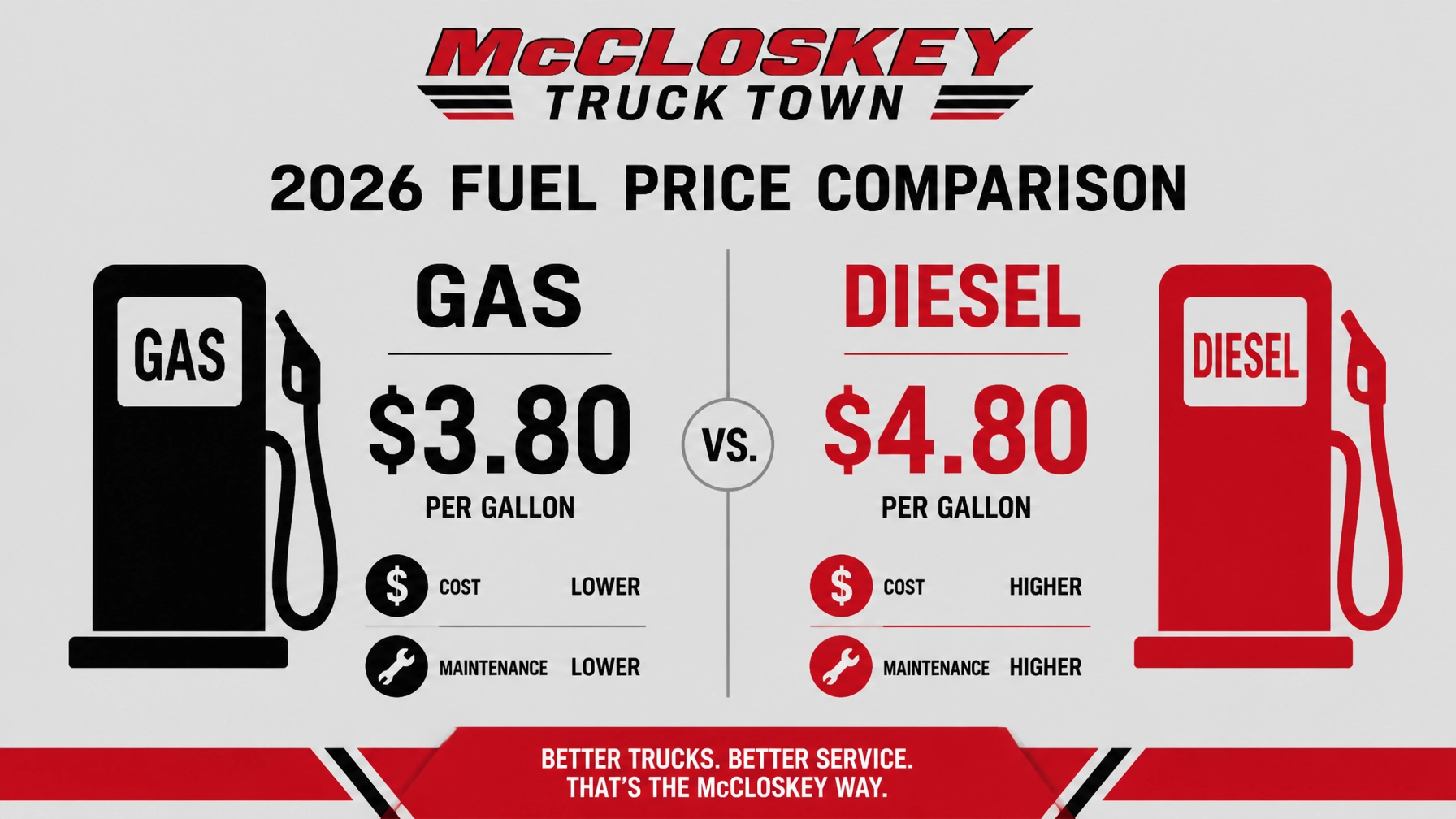
Choosing between a gasoline engine and a diesel powerplant has long been a defining decision for truck buyers across the Pikes Peak region. For decades, the conventional wisdom suggested that diesel trucks eventually paid for themselves through superior fuel economy and higher resale values. As we move through 2026, the economic landscape in Colorado Springs has shifted significantly due to fluctuating fuel prices and the increasing complexity of modern emissions systems. Buyers visiting our lot often ask if the traditional diesel advantage still holds true when regular gasoline is priced at roughly $3.80 per gallon while diesel sits near $4.80. This significant price gap at the pump means that the math behind truck ownership requires a much closer look than it did a few years ago. Our team at McCloskey Truck Town views our role as advisors, helping you navigate these technical trade-offs to find the vehicle that fits your specific budget and driving habits. Whether you are searching for a Colorado diesel for sale near me or a reliable gas-powered alternative, understanding the total cost of ownership is the first step toward a smart purchase.
The most immediate factor in the gas versus diesel debate is the daily cost of keeping your tank full while navigating I-25 or climbing toward Woodland Park. While it is true that a diesel truck typically offers twenty to thirty percent better fuel economy than a comparable gas model, the current price premium for diesel fuel often erases those gains. If a gasoline truck averages fifteen miles per gallon and a diesel truck averages twenty, the cost per mile becomes surprisingly similar when diesel costs a full dollar more per gallon. In this common scenario, the diesel truck only saves about one cent per mile in fuel costs, which translates to a meager two hundred dollars in savings over fifteen thousand miles of annual driving. This small margin is rarely enough to offset the significantly higher purchase price of a diesel vehicle in the current market. Many buyers find that a Colorado truck for sale with a modern gasoline engine provides a more predictable monthly budget for daily commuting and light hauling. We recommend running your own mileage calculations based on your typical weekly routes before committing to the higher upfront investment of a diesel powertrain.
Performance at altitude is another critical consideration for anyone living in the shadow of the Front Range or frequently crossing the Palmer Divide. Gasoline engines, particularly naturally aspirated V8s, tend to lose roughly three percent of their power for every thousand feet of elevation gain due to the thinner air. This means that at the six thousand foot elevation of Colorado Springs, a gas truck may feel noticeably less responsive than it would at sea level. Turbocharged diesel engines compensate for this altitude much more effectively by forcing more air into the combustion chamber, which allows them to maintain peak torque even on steep mountain grades. If your primary use involves towing heavy trailers or hauling equipment up toward the high country, the effortless power of a diesel may justify its higher operating costs. However, modern gasoline trucks have bridged this gap significantly with high-output turbocharged configurations that offer better high-altitude performance than the V8s of the past. Balancing the need for mountain-climbing power with the reality of daily fuel costs is a key part of the selection process at McCloskey Truck Town.
Maintenance and repair costs represent a significant portion of the long-term ownership equation that many buyers overlook during the initial excitement of a sale. Diesel engines are heavy-duty machines built for longevity, but they require specialized care that comes with a higher price tag at our service centers. A typical diesel oil change can cost two to three times as much as a gasoline oil change because these engines require a much larger volume of specialized synthetic oil and more expensive filters. Additionally, diesel owners must account for the ongoing cost and maintenance of Diesel Exhaust Fluid (DEF) and the complex Diesel Particulate Filter (DPF) systems required for modern emissions compliance. Gasoline engines are inherently simpler, with fewer high-pressure components and no need for specialized exhaust additives, which leads to lower routine maintenance bills over the life of the vehicle. When searching for truck sales Colorado springs, savvy buyers often prioritize this simplicity to avoid the potential for multi-thousand-dollar repairs associated with aging diesel emissions hardware. Our service team at McCloskey Truck Town can walk you through the expected maintenance schedules for any vehicle in our inventory to ensure you have a clear picture of future costs.
One of the most valuable benefits we offer at McCloskey Truck Town is the McCloskey Limited Powertrain Warranty, which provides significant peace of mind for pre-owned buyers. This coverage spans two months or two thousand miles and protects vital components such as the engine, transmission, and transfer case on qualifying vehicles. To qualify for this protection, a vehicle must be ten model years or newer and have fewer than one hundred and twenty thousand miles on the odometer. It is important for buyers to note that this warranty applies specifically to gasoline-powered vehicles, as diesel engines, exotics, and high-performance models are excluded from this specific program. This distinction underscores the inherent differences in repair complexity and parts costs between gas and diesel powertrains in the modern era. By choosing a qualifying gas-powered truck, you gain an extra layer of protection that helps mitigate the risks often associated with buying a used vehicle. We encourage you to visit BigJoeTruckTown.com to view our current selection of warranty-eligible trucks and SUVs.
Resale value and depreciation are the final pieces of the puzzle when determining which engine type actually saves you money over several years. Diesel trucks historically hold their value better than their gasoline counterparts, often retaining seventy percent or more of their original price after five years of use. This strong resale performance is driven by the perceived longevity of the diesel engine, which many buyers believe is only just reaching its prime at one hundred thousand miles. Gasoline trucks tend to depreciate more rapidly, which can result in a lower trade-in value when it comes time to upgrade to your next vehicle. However, the initial purchase price for a diesel truck is typically eight thousand to twelve thousand dollars higher than an equivalent gas model in the used market. When you calculate the total depreciation in actual dollars rather than percentages, the gap between the two often narrows significantly, sometimes even favoring the gas truck. This is especially true if you plan to keep the vehicle for a shorter period, where the high entry cost of the diesel is harder to recover at the time of sale.
The decision ultimately comes down to your specific use case and how much you value the unique characteristics of each powertrain. If you are a high-mileage driver who spends most of your time on the highway towing heavy loads through the mountains, the diesel's efficiency and torque are likely worth the premium. For the majority of Colorado Springs residents who use their trucks for daily commuting, weekend projects, and occasional camping trips, a gasoline engine is almost always the more economical choice. Gasoline trucks are cheaper to buy, cheaper to maintain, and simpler to repair, all while offering more than enough capability for most recreational and professional needs. Our team can help you compare specific models side-by-side to see how the numbers work out for your unique financial situation. We pride ourselves on transparency and want to ensure that every customer leaves our lot with a vehicle they can afford to enjoy for years to come.
As you consider your next purchase, remember that the "best" truck is the one that solves your practical problems without creating new financial ones. We invite you to explore our extensive inventory of over two hundred and fifty pre-owned vehicles to see the variety of gas and diesel options available right now. Our online tools, including the pre-qualification form and car loan calculator, make it easy to start the process from the comfort of your home. You can also visit our location on North Academy Boulevard to speak with an expert and take a few different models for a test drive. Whether you prioritize the raw power of a heavy-duty diesel or the sensible economics of a well-equipped gas truck, we are here to support your journey. Visit BigJoeTruckTown.com today to see why we have earned the BBB Excellence in Customer Service award eight years in a row.
Frequently Asked Questions
Does a diesel truck really last twice as long as a gas truck? While diesel engines are built with heavier components to withstand higher compression, modern gasoline engines have become remarkably durable and can often reach two hundred thousand miles with proper care. The main difference is that a diesel engine at one hundred thousand miles is often considered to be in its mid-life phase, whereas a gas engine of the same age may require more frequent preventative maintenance. However, the higher cost of diesel parts means that even though the engine lasts longer, keeping it on the road can be more expensive over time.
Is DEF really that expensive to maintain? Diesel Exhaust Fluid is relatively inexpensive on its own, typically costing between three and five dollars per gallon at most truck stops or auto parts stores. The real cost associated with DEF lies in the complexity of the sensors and heating elements required to keep the system functioning properly in Colorado's cold winters. A failure in the DEF system can trigger a "limp mode" that limits the truck's speed until the repair is completed, which can be a significant inconvenience and expense.
Will a gas truck struggle to pull my camper over Monument Hill? Modern gasoline trucks equipped with turbochargers or high-torque V8 engines are more than capable of handling the grades on I-25 and Highway 24. While they may downshift more frequently than a diesel would, they are designed to operate at higher RPMs to generate the necessary power for towing. If you are towing a trailer that is near the maximum capacity of your truck, you will notice the difference in ease, but for most standard campers and trailers, a gas engine performs perfectly well at Colorado altitudes.
Why does McCloskey Truck Town exclude diesels from the Limited Powertrain Warranty? The exclusion for diesel engines is based on the significantly higher cost of parts and labor associated with diesel engine and emissions repairs. Because a single major diesel repair can cost several thousand dollars more than a comparable gas engine repair, we focus our warranty program on the gasoline-powered vehicles that make up the majority of our inventory. This allows us to provide a reliable and sustainable protection plan for our customers while keeping our vehicle prices competitive.
Which engine type has a better trade-in value at McCloskey Truck Town? Diesel trucks generally command a higher trade-in value because of the high demand for used diesel powerplants in the secondary market. However, we evaluate every vehicle based on its individual condition, maintenance history, and current market demand in the Colorado Springs area. A clean, well-maintained gasoline truck with low mileage can often be just as desirable to our team as a diesel model, especially for buyers looking for lower operating costs.
McCloskey Truck Town 5515 N Academy Blvd Colorado Springs, CO 80918 (719) 685-7007 BigJoeTruckTown.com